Showing posts with label publishing future. Show all posts

Friday, April 30, 2010

Independent Publishers, Meet Your Audience. Lessons from Indie Labels

Ken Auletta's "thorough and thoughtful exploration into Kindle-iPad-publisher tensions leaves you with a lot to consider. As he traverses his way through the current e-book jungle, he details publishers' (non)relationship to their audience:

...It would take years for publishers to learn how to sell books directly to consumers. They do not market research, have little data on their customers and have no experience in direct retailing. With the possible exception of Harlequin Romance and Penguin paperbacks, readers have no particular association with any given publisher; in books, the author is the brand name. To attract consumers, publishers would have to build a single collaborative Web site to sell e-books, an idea that Jason Epstein, the fromer editorial director of Random House pushed for years without success.

It's an interesting point; publishers think of retailers, not readers, as their customers, thus many publishers never connect with their authors' audience. Whatever is left of a press's marketing department is devoted to authors without consideration for the company. Yet, independent publishers' potential to draw attention by their own merit is huge.

Perhaps the indie press should take note of their music label brethren. While Warner Music or EMI do not (possibly could not) create their own fans, there are intensely loyal followings for indie labels of every genre. Listeners identify with the indies for the point-of-view, personality and lifestyle that they stand for. Labels directly engage fans as well as form trust through the music they support. A label's fans will try out new artists, check out new releases, and attend record label tours because of the label as well as the musician. Heck, my sister loves Trojan Records so much she had its logo tattooed.


This type of inherent value and trust can be cultivated by indie publishers. Some are starting; more need to. After all, literary aficionados want ink too.


Friday, April 9, 2010

Going Retro. What Internet Reading Means to Writing

This article has had me thinking about what internet reading could mean to the writing process. No one knows what the ultimate results will be, but what does seem to be happening is a revival of previously defunct forms of content delivery. Take the serialized story, for instance. While rumored to have survived in literary nooks and crannies, the serialized story essentially burned out after its heyday in 19th century magazines. Until now. In its new digital suit, the serialized story has returned to us.

Five Chapters is one such site that features quality short stories by breaking them into five parts and delivering them throughout the work week. This site differs from the typical e-reading hot spots in one critical way: it's incredibly quiet: no hyper-linked text, no advertisements, no blog roll. It is, rather, a zen-like reading corner of the Internet universe that presents just enough content for the average person to read comfortably online.

I subscribed to Five Chapters' feed to give the site a test drive, and I must say, I'm really happy with the results. The stories are loving-crafted with the kind of characters that follow you around after you click elsewhere. Having only heard of few of the 192 authors featured, I feel pretty good about myself after I read. This is simple (and, honestly, time-efficient) way to introduce yourself to writers that are normally drowned out by the buzz of big six advertising.

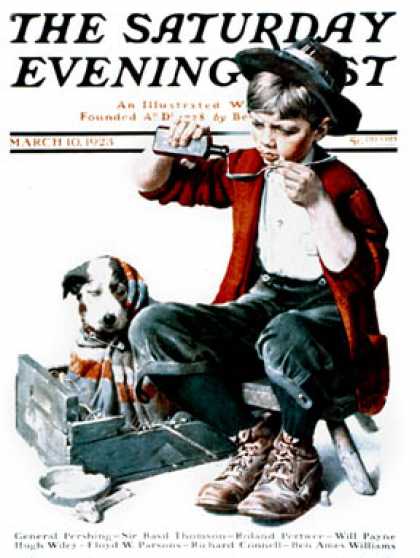
Dave Daley says he designs the content to fit into a lunch break, but, personally, I prefer to wait until the end of the day. Coming home to a new issue gives me that cozy, homey, Americana feeling that I've only glimpsed at in Norman Rockwell paintings. For me, it's a bit like coming home to the afternoon paper.


Saturday, April 3, 2010

Amazon strikes again. What's an indie to do?

Just the Macmillian-Amazon standoff cools down, Amazon picks yet another fight. Add threatening independent publishers to the growing list of loss-leader strategies, intentional Kindle incompatibility and removal of buy buttons. Amazon is on a role.

With Apple courting indie publishers as they prepare to launch the iPad and iBookstore, Amazon is attempting to curb any power over ebooks that publishers could possibly retain. While it can't pull these antics with the big six, the company thinks it can push the smaller presses around. Amazon is betting that indies, who rely heavily on internet sales, will not be able to survive without Amazon sales. So, the company is threatening to cut them off at the knees if they sign the (more fair and balanced) Apple contract.

But there are signs of hope. Perseus Books has signed on with Apple regardless of Amazon's threats. As the largest independent publisher and distributor of another 330 independent presses, Perseus is setting up a good line of defense. If most small publishers follow suit, Amazon will have to back down lest Apple appear to offer the broader selection. On its own, an indie is a sitting duck, but collectively, Amazon needs them more than they need Amazon.

Amazon's behavior is appalling. Over and over again, the company flexes corporate muscle in order to force the entire book industry to bend to its will. Simply put, the company is trying to determine how strong its monopoly hold is. It is absolutely necessary that publishers deny this corporate bullying now. If Amazon gets away with its behaviors in these early days of digital conversion, the company will be setting the pace and the unsustainably low prices for a long time. Singlehandedly, Amazon could dismantle entirely an all ready fragile industry.

Saturday, March 27, 2010

Fear and Loathing in the Book Industry

It doesn't matter if you are a local plumbing company or a major record label, you are undergoing digitization in your industry. Understandably, a good dose of anxiety is accompanying this change. Will your new websites, blogs and digital products be worth the investment? What are the new standards? How necessary is digitization for you? Typically alongside this fear is enthusiasm and opportunity. The new media offer tremendous possibilities for both corporate and independent companies, but the publishing industry seems to have skipped the possibilities section of this brave new digital world.

The literary press holds its breath at every single development or upset. Whether it's Amazon throwing around its monopolistic weight or an indie press subverting the standard book release process, the industry watches with apprehension, fear and even anger. Many publishers do not have a level of digital fluency. E-books, blogs and twitter accounts are seen as an impending giant casting a shadow over their once peaceful village.

Their anxiety is making them resistant to changes that, for better and worse, are not able to be stopped. To quote the iconic Richard Nash:

The publishing business is not in trouble because there's no demand for books. It is in trouble because there are changes afoot in how best to satisfy the demand, changes to which there are suitable responses, two of which are fostering fan culture and generating a sense of occasion, and the leaders of the largest publishing organizations are failing in their professional responsibility to implement these responses. By reducing their participation in BEA at the same time the media participation has increased by almost 50%, by refusing to open the Fair to the readers on Sunday, these CEOs have effectively thrown in the towel. They are managing the demise of the book business, pointing fingers at any generic social forces they can find, failing to see the one place the responsibility can be found, their own damn offices.

Many publishers are becoming their own worst enemy. Absolutely, risk is implicit in experimentation, but risk, at least, offers a chance for success as well as for failure. Standing still is suicide.

In this interview, Don Linn offers thoughtful and sane advice for publishers. Start educating yourselves, start experimenting with the less expensive new media forms. Get in the game or you will get left behind.


Saturday, March 20, 2010

The Replacement Press releases their first book

As an infant press in the Twin Cities, the Replacement Press is a publisher to watch. Composed of a husband-and-wife team, they publish out of their apartment, maintain day jobs and pour themselves into their venture. Both in their late twenties, Andrew and Sarah De Young have one solid advantage: an ease with the social media that makes other publishers cringe. They tweet, update their facebook status, post faithfully to their blog. They see ebooks and digital readers as a possibility to diversify literary voices rather than as a death blow to independent publishing. I see them as the potential of indie publishers' future: passionate, adaptive, glocal.

Perhaps I'm drawn to Andrew and Sarah De Young's adventure because their success could go beyond the personal. Starting from a vantage point inside the new digital era, they could begin to set the pace for 21st century publishing. After reading so many blog posts and news articles about the dim future of publishing, the Replacement Press offers an encouraging counterpoint. Yes, they are young. Yes, they are a fledging company, but they are creative, flexible and fueled by new possibilities.

As their first book launches this weekend, I wish them the best and will be following their progress.

Friday, March 5, 2010

Tit for tat: what digitization means to the writing process

This post is among several recently that have questioned what changes in media formats mean for the writing process. How will writers contend with e-books and vooks? Do they change the writing process?

The implication is often that new forms will facilitate a poor quality of writing. Me, I'm not so certain that the digital formats are a threat to quality writing, but I understand the concern. Digital formats seem to be occurring in a less organic way than we're used to. Typically new formats evolved as writers push and stretch standard forms until someone breaks the barriers alla "The Wasteland" or "Ulysses." Certainly, in the cases of vooks or kindle, the experiment seems to have come before the experimenter. But this was also the case with the Gutenburg press.

Do writers who create in the new formats suffer a creative crippling because of e-structures? The writing process has always and will always take form into account. A writer does not approach an essay in the same way a novella. Structure carries its own set of restrictions and opportunities that influence the final product. Kindles and blogs are no different.

Perhaps what unnerves us is the sudden onslaught of so many new types of final products, so many new considerations. But I have faith in our literary craftsmen. A new format will not change a writer's intention. Regardless of available formats, a writer choices to produce lead or gold. Perhaps because big publishing houses are transitioning with best-sellers and pulp-style writing, we get the impression that this type of writing will set standard. Well, that's their standard for the old formats, too.

But the steps between a writer or (an indie publisher) vastly decrease with the new formats. Costs shrink, and visibility rises in a way that begging a corporate bookstore for shelf time never accomplished. So perhaps, ebooks and kindles can encourage unestablished writers. Whether or not they strike it big, their literary children can enter a world that was previously an impossibility.


Wednesday, February 24, 2010

Baby steps toward publishing future

Neither over-optimistic nor fatalistic, Jason Epstein's "Publishing: the Revolutionary Future" has given us a lot to think about. Here, he lays out a detailed vision of the digital future of books, and I walk away feeling...mixed. I think about his idea that, one day, when all books are digital, libraries and bookstores will not be needed, technically neither will books. We will go to websites for our digital libraries and retailers and instantly download our selections from a infinite backlist, some server out there somewhere that contains all the books ever written. A digital Library of Babel.

Maybe I'm just old-school, but I have trouble imaging not being able to wander around a bookstore or waiting at the counter of its cafe for the appearance of some kid whose sobriety I question. But Jason goes on and points out what many others have said. Bookstores aren't really what they used to be. With the onslaught of corporate retail presence combined with a thirst for high-risk, typically low-quality, bestsellers, the diversity inside bookstores has greatly diminished. When we browse there, we find less good, quirky, new and more okay, predictable, same. Perhaps, without the high cost of physical presentation in a storefront, we book-shoppers will find more to browse through, books we never knew existed because, previously, we could only view the tip of the iceberg.

Search This Blog